
Noncitizen Voting
Examining the facts around noncitizen voting — the existing safeguards, the data, and why the evidence shows it is exceedingly rare.
The Illegal Immigration Reform and Immigrant Responsibility Act of 1996 explicitly prohibits noncitizens from voting in federal elections. It is a felony and deportable offense for a noncitizen to cast a ballot for federal office. While federal law does not bar noncitizen voting in state or local elections, no state currently permits noncitizens to vote in statewide elections.
Allegations of widespread noncitizen voting are not supported by the evidence. Registration and voting attempts by noncitizens are investigated and, where appropriate, prosecuted. Available data consistently show that such cases are exceedingly rare and have not been significant enough to affect the outcome of any election.
Recent statewide reviews by Republican-elected leaders, Trump Administration officials and experienced battleground state election administrators underscore this point:
- In 2026, the Federal Bureau of Investigation, working with Nevada voter roll information and Dept. of Homeland Security citizenship data, closed a voter fraud inquiry after finding only 38 possible non-citizen voters in the 2020 election.
- Utah conducted a 9-month comprehensive citizenship review of its entire voter registration list. After a detailed, multi-step examination of more than 2 million registered voters in 2026, officials identified just one confirmed instance of noncitizen registration and zero instances of noncitizen voting.
- Idaho, with more than 1 million registered voters, conducted similar reviews in 2024 and identified 36 individuals deemed “very likely” to be noncitizens. Secretary of State Phil McGrane noted the total who may have previously voted amounted to roughly 0.001% of registered voters — a fraction far too small to influence statewide election outcomes.
- Louisiana reported in 2025 that 390 noncitizens were found on its voter rolls, with 79 having cast ballots at some point over several decades. That figure comes from a registration base of approximately 2.9 million voters.
- Montana identified 23 possible noncitizen registrants out of roughly 785,000 registered voters.
- In October 2024, Georgia Secretary of State Brad Raffensperger announced that a citizenship audit of 8.2 million registered voters identified 20 noncitizens who had registered to vote. Nine of those individuals had previously cast ballots, most before Georgia strengthened its citizenship verification procedures in 2012. All cases were referred to local prosecutors.
- In October 2025, the Texas Secretary of State’s office announced that it had used SAVE to identify 2,724 voter registration records that potentially belonged to noncitizens. This inflated allegation is only roughly one-hundredth of one percent of active registered voters in Texas. The secretary of state’s office distributed the list of identified records to county election officials for further investigation. A series of reports from December 2025 indicate that a large percentage of flagged records belong either to confirmed citizens or individuals who were registered in error by government officials.
- A preliminary state investigation into potential noncitizen voters in Macomb County, Michigan, found one noncitizen who had cast a ballot in the county in 2018. Several people whom the county flagged as potential non-citizen voters were actually determined to be U.S. citizens.
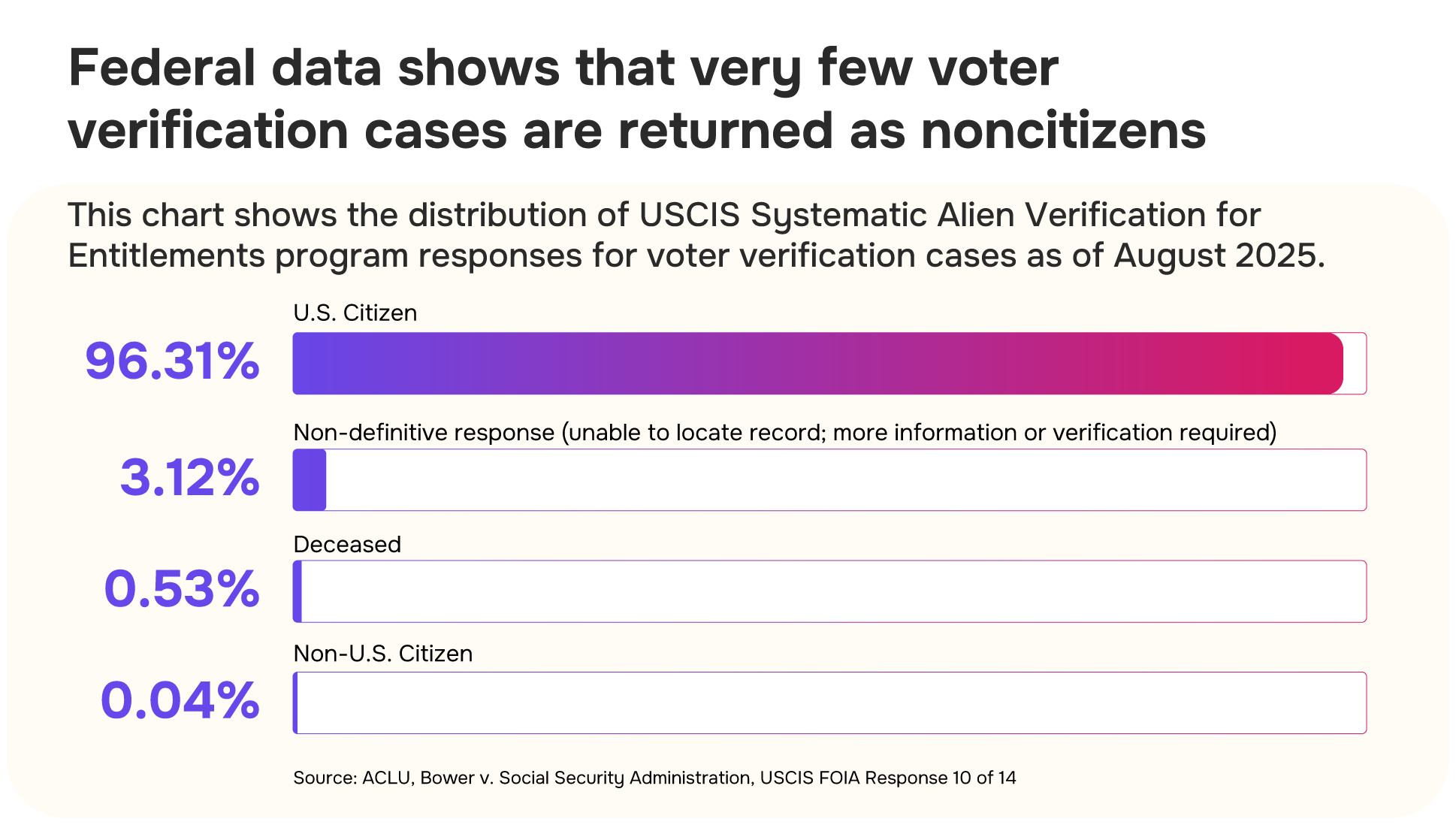
In addition, many states began using the U.S. Citizenship and Immigration Services’ Systematic Alien Verification for Entitlements (SAVE) program in 2025 to further verify the citizenship of registered voters. Data from these verification efforts indicate that approximately 0.04% of cases reviewed are returned as noncitizens.
Federal data shows that very few voter verification cases are returned as noncitizens
This chart shows the distribution of USCIS Systematic Alien Verification for Entitlements program responses for voter verification cases as of August 2025.
The libertarian Cato Institute confirms: “Noncitizens Don’t Illegally Vote in Detectable Numbers.” Also, the Heritage Foundation’s database of election crimes listed only 24 instances of noncitizens voting in U.S. elections from 2003 to 2023.
Taken together, these findings demonstrate that noncitizen registration and voting are extremely rare occurrences, regularly scrutinized, and statistically negligible in the context of statewide and federal elections.
Further Reading
- 1."Update: Review of Claims of Noncitizen Registrants and Voters" Center for Election Innovation & Research, Feb 15, 2026.
- 2.Richer, Stephen. "What’s Really Driving These Bogus Claims of Voter Fraud" The New York Times, Feb 6, 2026.
- 3.Sullivan, Andy. "Noncitizen voters a rarity in US elections, state and private reviews show" Reuters, Oct. 3, 2024.
- 4.Lieb, David. "Data indicates voting by noncitizens is rare. Republicans are pressing measures to make sure of it." Associated Press, Sept. 9, 2024.
- 5.Nowrasteh, Alex. "Noncitizens Don’t Illegally Vote in Detectable Numbers" Cato Institute, Nov. 25, 2020.
Safeguard Spotlight
Learn more about how states are working daily to protect election accuracy and security.
Protect the Integrity
of Every Vote
Share your information for the latest news from RightCount, or sign up to protect the counting and certification of elections in your community.